In nearly all my programs and workshops I recommend adding a MISTER to your wildlife habitat. This suggestion is often met with some confused looks, so I thought I’d follow it up here with some photos that can help walk you through it and understand how simple it can be. NO ELECTRICITY needed, just a hose connection.
Why a mister, you may ask?
A mister can serve a dual purpose: (1) offering a place for songbirds, including hummingbirds, to bathe, and (2) moistening an otherwise dry part of your garden where you can plant goodies under it that like wet feet, like Cardinal Flower, Swamp Milkweed, Turtlehead, etc.
Misters are especially crucial during rainless summers when everything is bone dry. To a hummingbird, a bird bath is like the Atlantic Ocean and they’ll never use it. Instead hummingbirds need rain showers, garden sprinklers (which few of us use because we’ve planted NATIVES which need little pampering), or A MISTER!
Set up properly, a mister mists down from a nice height over leaves and plants beneath it, drawing in hummingbirds that will fly through it to take a bath or roll around on wet leaves below to bathe, as will warblers and other songbirds as well. We’ve seen some of our neatest garden visitors at the mister!
American Redstart (a warbler) bathing under our misterGray Catbird bathing under our misterCarolina Chickadee bathing under our misterYelow Warbler bathing under our mister on all the wet Pokeweed leaves. We happily let Pokeweed flourish in the shade under our pines where nothing else easily grows – it’s an incredible bird food and a stunning native plant
Do I need Electricity? NO!
NO electricity needed . . . just a hose connectionBe sure that you buy a mister that has 50-60 feet of tubing so you can wind it up a tree and out a branch.Simply turn your hose on in the morn and off at dusk or set up a hose faucet timer to accomplish that automatically
You can set your mister up on a hose faucet timer so that it comes on in the early morning and goes off at dusk (or whenever it suits you), or you can simply turn the hose on that is connected to your mister when you want it to come on and turn that hose off when you want it to stop misting (as we do). We turn ours off at dusk. Obviously, on rainy days we don’t turn it on.
Where Oh Where Can I Find a Mister?
Misters are sometimes sold at Nature Centers. Be sure you find one that has 50-60 feet of 1/4 ” black tubing (along with the special mister unit at the end); that way you can easily snake it up into a tree and out to the end of a branch so the mist mists out over a nice-sized area.
On line, a few places I found them available were:
Another product I’ve been told about, but not yet tried is a Fan Mister, like the average person might use around their swimming pool. Wildlife gardeners can adapt one and use it as a bird mister. Here’s one (and apparently they’re available at places like Lowes and Home Depot when all the summer stufffffffffffffffff is out):
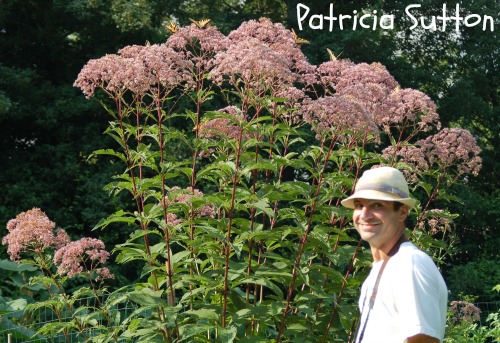
Josh Nemeth in his 2-year old garden, dripping with Tiger Swallowtails (7-21-13)
Hi Gang,
It’s been a wild, cold, and snowy winter. I’ve been enjoying all the birds that are finding refuge in our wildlife garden. Our heated birdbath has attracted 100s of birds this frozen winter, including a normally very secretive Hermit Thrush and a quite uncommon wintering bird, a Gray Catbird.
Speaking of wildlife gardens, I can’t wait to once again teach the series of 6 in-depth “Gardening for Wildlife” Workshops (pdf), on Saturdays (February 8 – March 29, 2014), the perfect time to shake off winter and begin planning and planting (or enhancing) your property and wildlife garden.
Many (1000s) have taken these workshops, been empowered, and created habitats that have given them pleasure for years to come.
They know and I know that there is nothing like stepping out the door into a magical wonderland that you yourself created, full of hummingbirds buzzing about,butterflies dancing from flower to flower, Monarch caterpillars hiding under Milkweed leaves, hungry songbirds dropping in during migration for a hearty caterpillar meal,dragonflies galore, more frogs than you realized lived in your area (perched on every last lily pad in your pond). There is nothing more gratifying than realizing that you have truly provided safe haven for all these creatures
Consider joining me for one, two, or all six of these workshops. Native plants and wildlife-friendly practices are the key and will be emphasized and detailed throughout.
I present a zillion one- to two-hour programs each year and maybe you’ve attended a few of these. I love teaching them, but (with only one or two hours) they are more one-sided presentations, me sharing fun natural history information and images with you, the audience.
These workshops offer the opportunity to be far more in-depth and interactive and are more likely to empower you, take you to the next level.
The 5-hour format (10 a.m. to 3 p.m.) allows for:
an interactive workshop atmosphere
each workshop covers a unique aspect of wildlife gardening (in-depth)
each workshop builds on the others, but is not repetitive (so you’ll want to try and attend all 6 to maximize your learning opportunity)
resources (handouts and circulated books) will be shared and showcased
you’ll learn how to utilize these resources (find answers to burning questions you may have)
time for in-depth questions
time for in-depth answers
during a working lunch we’ll brainstorm (as a group) each participant’s specific challenges (you’ll draw a rough sketch of your yard and submit a photo of your sketch that I’ll project so we can all see it for this brainstorming)
time to get to know one another and learn from each other (of garden triumphs and tribulations, successes and pitfalls). Nothing beats collective experience and roundtable discussion
each workshop will culminate in a site visit to a nearby backyard habitat where wildlife-friendly practices and design and plant selections will be showcased
So, what do you say! Will I see you in February & March?
Sign up today and begin getting ready for the workshops. Draw a rough sketch of your yard, indicating structures (and hardscapes like driveways, decks, etc.), existing habitats (lawn, forest, lone trees, shrub islands, gardens, bird feeding station, brush pile, etc.), and mark NORTH, SOUTH, EAST, WEST on the sketch. Take time to note the sun’s path through your yard and where the sunniest areas are. Bring a wish list of the elements you want to add as well as the elements you need to work around.
Where: Please note that the 6 workshops in this series will be held at the Cape May Bird Observatory Center for Research & Education, 600 Rt. 47 N, Cape May Court House, NJ 08210 (and include a site visit to Sutton’s nearby wildlife gardens) and not at the Nature Center of Cape May in Cape May.
Limit: 20 participants; preregistration is required (through NJ Audubon’s Nature Center of Cape May, 1600 Delaware Avenue, Cape May, NJ 08204; 609-898-8848 — if you reach their message machine, do leave a message . . . they’ll get back to you).
Cost/workshop: $35 member of NJ Audubon Society, $45 nonmember (includes handouts). As of 2-13-14, sign up for last five workshops for a DISCOUNT:
Members: $150 ($30/workshop) and 20% off in the gift shop
Non-Members: $200 ($40/workshop) and 20% off in the gift shop
********************************************************************************************************
Having written the book, How to Spot an Owl, and studied owls for the past 35 years, Clay and I have NEVER seen a winter like this one and probably never will again in our lifetime. This winter’s Snowy Owl invasion is that special.
Invasion of 1926-1927 When 1,000s of Snowy Owls Were Killed
One of our favorite books is the Book of Owls, by Lewis Wayne Walker. Walker wrote of the Snowy Owl invasion during the winter of 1926-1927, stretching from Canada to North Carolina and west to the Dakotas. Sadly it was the dark ages for predators. Many were killed that winter and taken to taxidermists. One ornithologist checked in with taxidermist shops across the northern states and learned of 2,363 Snowy Owls killed and brought in to be mounted as trophies. Sadly the death toll was many, many times higher since most Snowy Owls were killed for target practice or “predator control” and left behind.
We’ve come a long way since those dark days for predators. But still there is concern. News coverage has been nonstop this winter. Droves of people are out and about looking to see a Snowy Owl. Many have never encountered one before and have only seen them on television or in Harry Potter films.
In our book, How to Spot an Owl, published 20 years ago in 1994, we included “Owling Etiquette.” We think it is timely to share it once again and bring it up to date as it applies to this winter’s invasion — an invasion coupled with today’s technology (cell phone cameras) and unprecedented easy access to Snowy Owls via newspaper coverage, text messages, e-bird, etc.
Do not approach too closely. Arrow points to a Snowy Owl on Stone Harbor Point.The same bird (my digiscoped photo, taken from a safe distance)
Owling Etiquette
If you are heading out to see a Snowy Owl, don’t leave your binoculars at home. Take binoculars and a spotting scope (if available) so you don’t have to get too close to get a good look. Chances are there will be other viewers. Don’t be shy. Ask to get a look through a telescope if one is available.
Do not approach too closely. You’ll know when you’re pushing the limits. The bird will turn from a sleepy, closed-eyes owl, to a glaring owl looking directly at you — a potential threat in their space.
A photograph is not a good enough excuse to crowd and disturb an owl. Chances are there will be other viewers with zip-zap camera systems that can capture an excellent shot from a safe distance away. Don’t be shy. Ask if they’d e-mail you one of their photos.
If you should unexpectedly discover an owl, be very still and quiet and do everything in slow motion
If you are too close to the owl and it fidgets and continues to look alarmed (when it should be sleeping during daylight hours), back off very slowly and quietly, keeping your profile low.
If you should come upon owls roosting by day in wooded settings (owls such as Long-eared, Barn, and Saw-whet Owls), sink slowly to the ground to appear less threatening. If the owl no longer feels threatened, you may get to watch it relax – a real treat.
How close is too close? Actually that is circumstantial. This winter we watched a Snowy Owl at Reeds Beach perched beyond the end of the road end, on a piling across a waterway — much closer than we’ve ever been to a Snowy Owl. If the water had not been between us we never would have gotten that close.
Use basic common-sense etiquette at all times. Respect private property, “no trespassing” signs, “Keep off the Dunes” signs, and “area closed” signs in places such as Holgate. Your bad behavior could make visitors no longer welcome to an area.
Snowy Owls are attracted to areas that most resemble the open tundra, places like Stone Harbor PointSnowy Owl “hiding” by the one bit of vegetation out at the end of Stone Harbor PointEven though perched right out in the open, they often sit next to a bit of shelter which helps camouflage them
Where to find Snowy Owls: Tundra-like Areas
Snowy Owls are attracted to areas that most resemble the open tundra, their normal habitat — a vast area above tree line, far from roads and people. Here in New Jersey most of the Snowy Owls are drawn to the coast, especially areas that have been spared development – natural beaches, windswept dunes, and the marshes behind the barrier islands. You might find a Snowy Owl sitting on the open beach, a dune fence, an Osprey platform or muskrat house in the marsh, or up in the dunes. Sometimes a rooftop offers a Snowy Owl not only a good view of feeding habitat, but also a respite from beach vehicles and beach walkers, people and their dogs.
It is important to realize the value of natural habitat to these birds. They are selecting meadows, marshes, fields, and prairie-like areas (airports), open areas that harbor potential prey (mice and voles and birds).
While here Snowy Owls are preying on rodents as well as rabbits and birds, including ducks in back bay and ocean waters. They’re opportunistic hunters like most predators, probably finding lots of prey during tough winter conditions when other wildlife is struggling.
It is Easier Than Ever to Find a Snowy Owl
The Snowy Owl map on eBird is updated day-by-day by people all over with their sightings. Be sure the date box at the top shows November-April, 2013-2014 to see sightings from this winter’s invasion. Once there you can zoom in closer and closer until you can see sighting details in your own area.
Snowy Owls are quite sedentary by day, often appearing to be sleeping with their eyes closed or nearly closedBy late afternoon Snowy Owls come alive and begin to hunt, often from their perch – turning this way and that way as they detect prey with their keen vision and hearing.
Do Snowy Owls Ever Fly or Open Their Eyes?
This lovely northern owl, like other owls, is quite sedentary by day. Most owls are nocturnal, night-time hunters. Snowy Owls hunt through the night, but are also crepuscular (active during the dim hours of dawn or dusk) when here in winter. They begin to get very active as dusk approaches.
Most owls hide in deep cover by day – hence why owls are so elusive. But Snowy Owls, being birds of the open Arctic tundra, often sit in plain view during the day. Through the day they appear to be sleeping with their eyes nearly closed, but they are ever vigilant for ground predators and other potential threats. The daytime is their down time. Once you’ve found a Snowy Owl, there’s an excellent chance it will remain at that very spot all day long unless it is harassed or flushed or threatened. So, by all means give them their space and don’t crowd them.
This Snowy Owl has detected prey. It is trying to get a better look and a better listen
If you want to see a Snowy Owl fly and hunt, you have a brief window at the end of the day. Return in the late afternoon, about 4:00 p.m. and plan to watch the owl you found earlier in the day as it comes alive and begins to hunt. Bring your binoculars and a telescope and study it from a safe distance.
The few Snowy Owls that wander south most years begin to appear around Thanksgiving. That was the case this winter. But by early December record-setting numbers appeared. Snowy Owls will spend the winter here, remaining through March when some birds will head north. Others may remain through much of April and then head north. They will return north to the Arctic tundra, a land mostly beyond our reach, far far away. They may or may not return to where they were born, as it has been proven that Snowy Owls are highly nomadic in response to prey abundance (such as lemming population explosions).
Researchers are Following Snowy Owls This Winter
Our own encounters with Snowy Owls this winter have included intimate experience with Assateague, one of the tagged birds being followed by Project SNOWstorm. Follow Project SNOWstorm and consider supporting their research, assembled in record time to study this amazing invasion.
If you haven’t seen a Snowy Owl yet this winter, don’t miss this once-in-a-lifetime opportunity when they’re here in incredible numbers. A good place to start might be Forsythe NWR where one to three Snowy Owls have been seen since late November, either on the wildlife drive or sitting on the visitor center.
Head out for owls, though heed our advice and practice owling etiquette. Speak up if you witness someone crowding an owl. Chances are they are misinformed or unaware and think the owl is tame (and not a wild creature) or not bothered by crowding (which we all know is far from the truth). Send them to this website so they can be informed and enjoy these Arctic visitors without disturbing them.
I just returned from a far and distant land where thousands upon thousands of butterflies filled the many native plant wildlife gardens that I visited during my 10-day stay, which included the 18th Annual Texas Butterfly Festival.
Many of the butterflies were exotic (to me) southern species that just make it into the United States.
Since my first visit in 1979 to the Lower Rio Grande Valley, I’ve made 7 additional trips. That first visit in 1979 was kind of scary. It was in spring and Clay and I witnessed major fallouts of Broad-winged Hawks and other migrant birds at places like Santa Ana National Wildlife Refuge. Exiting the refuge and looking north we cringed. Farm fields stretched as far as we could see without a tree or hedgerow in sight. How could these migrants survive once they left refuges like Santa Ana NWR?
Mexican Bluewing
Thirty-four years later I am hopeful and hugely impressed with favorable changes to the landscape in the Lower Rio Grande Valley, changes that include natural corridors of native plants running between many of the protected parcels. The official Birding & Butterfly Map of the Rio Grande Valley (available for free at nature centers throughout the Valley) directs visitors and residents to 86 sites, many of which have extensive butterfly gardens planted with native nectar and host plants benefiting all pollinators and attracting insect-eating birds galore.
The area is a bonanza for those of us in the north, whose gardens have been quiet for a good month.
Drought gardening is the new normal. Here’s our garden July 6, 2010, during a lengthy, blistering hot and rainless stretch.
With rain so precious and drought gardening being the new normal, I wanted to know exactly how much rainfall my garden received.
So I joined the “Community Collaborative Rain, Hail and Snow Network (CoCoRaHS),” bought my official rain gauge for $25, and began collecting rainfall data during the recent nor’easter. I tallied a total of 4.02″ of rain between October 7-13, 2013. WOW!
Read all about it in my October 2013 Native Plants and Wildlife Gardens post, “Rainfall: How Much?”.
And consider joining CoCoRaHS to contribute additional data for a more complete picture (details in my post).
Monarch on Giant Sunflower in my fall wildlife garden
I am very concerned about Monarchs
This year, I’ve been asked more times than I can count, “Where are the Monarchs?”
It is now fall and Monarchs are migrating through Cape May on their way south to the mountains of Mexico where they will winter. They’re not absent. We’re seeing some. But few came from our wildlife gardens, where previously our gardens were responsible for generation after generation. My garden in all of 2013 (so far) has attracted less than 20 Monarchs and I’ve only found 1 caterpillar. That’s OFF, big time!
I fear that this coming winter (2013-2014) their numbers at the winter roost sites in Mexico will be even lower than last winter, which was the lowest in 20 years.
Read my latest post on Native Plants and Wildlife Gardens, “Where are the Monarchs in 2013?” to learn about the plight of eastern Monarchs and why we’re seeing so few.
Late-breaking GREAT news (and photos) from Jean Gutsmuth!
At the garden of a friend in Haddon Heights, New Jersey, the numbers of chrysalises hanging from EVERYWHERE on her house and garage is amazing; she estimated 95 to 100 on September 20, 2013. They are hanging from eaves, window sills, around door frames, and even on the bricks of her house. The friend shared that she never saw more than perhaps two pairs of monarchs at one time. Although she had a fairly good size garden of milkweed, it is pretty well stripped. Thank you Jean for giving us this GREAT news and sharing your photos. Let’s hope there are many more pockets of Monarchs like this!
Young Ruby-throated Hummingbird with pollen covering its head
As young leave the nest and as hummingbirds that nested on the Gaspe Peninsula in eastern Canada and other points north begin to move south, hummingbird activity in our gardens soars. The time to easily see lots and lots of Ruby-throated Hummingbirds is fast approaching: late July through first week in September.
2013 Tours of Private Hummingbird Gardens
That being the case, I’m once again looking forward to leading “Tours of Private Hummingbird Gardens.” This year I’ve scheduled the tours mid-week, to avoid summer-at-the-shore weekend traffic. Join me, if you can, to see 18 fabulous hummingbird gardens over a three-day period: August 20-22 (Tuesday-Thursday). My own garden (and Eleanor and Gordon’s Engel’s garden below) will be on the “North Tour” (August 22), but all the gardens are wickedly delicious and full of hummingbirds.
My own garden in mid-July. It will look completely different by the August “Tours of Private Hummingbird Gardens”Eleanor Engel in the meadow that she and her husband Gordon created after successfully removing bamboo – what a Success Story!
Enjoy my recent posts about hummingbirds on “Native Plants and Wildlife Gardens”:
Clay Sutton (on left) and his co-worker, James Dowdell (on right)
Exciting News!
As many of you know, besides writing, Clay has continued to work as an environmental consultant and field biologist for many years. This year, he reached a major milestone with the publication of “Status and Trends of Raptors and Waterbirds on the Maurice River, Cumberland County, NJ. 25-Year Study Results: 1987-2012.”This paper was presented and featured at the Partnership for the Delaware Estuary’s “Science and Environmental Summit 2013” held in Cape May in January 2013.
Sponsored by the praiseworthy group Citizens United to Protect the Maurice River and its Tributaries, Inc. as part of its efforts to discover, monitor, and protect the many natural resources of the Maurice River, this study and report is one of very few true long-term studies that examines the changing status of biological resources in the Delaware Estuary. The study has monitored winter raptor and waterfowl numbers for 25 years on this wild and scenic Delaware Bay tributary, and has examined all waterbird usage – particularly spring shorebirds and fall raptors – for the past ten years as well.
The official abstract is found below, but you can view two versions of this landmark report on the Citizens United – Maurice River website. The short version is a 14 page glossy illustrated summary, and for those who wish to review the changing statuses and trends in depth, the full 98 page report is also found on the Citizens United website.
This unique study is ongoing, and is now in its 28th year and counting (pardon the pun!).
Pledge Your Support for this Raptor-Waterbird Study
Support Citizens United’s important work and the Raptor-Waterbird study in particular by supporting their team (of which Clay is a member), The Fish Hawksin the World Series of Birding on May 9, 2015. Pledge on the team’s efforts by filling out Citizens United’s Donation form:
Include your pledge amount in the “Other Amount” box and
In the “Designation” box write in “W.S.B.” (for World Series of Birding).
You’ll be supporting this dynamic conservation group in their award-winning efforts to protect the incomparable Delaware Bayshore!
Citizens United to Protect the Maurice River and its Tributaries, Inc.
Under the auspices of Citizens United to Protect the MauriceRiver and its Tributaries, Inc., and with funding from the National Park Service, US Department of the Interior, and with goals of discovery, documentation, and conservation, raptors and waterfowl have been studied on Cumberland County, NJ’s tidal MauriceRiver for 25 years. Over 476 days of field work have been carried out in this long term study. Initially implemented to document avian ecovalues in response to industrial barging and dredging proposals, core winter raptor and waterfowl point counts have been maintained every season since 1987-1988. Significant increases are shown for Bald Eagle, Peregrine Falcon, Cooper’s Hawk, Black Vulture, Green-winged Teal and Canada Goose; substantial declines are seen for American Kestrel, Rough-legged Hawk, Am. Black Duck, Mallard, and Northern Pintail over the study period. Supplemental/adjunct fall raptor migration counts have been conducted at East Point, NJ to monitor the hawk migration moving west around Delaware Bay; in 60 days of observation in 1990 over 9,000 migrant raptors were counted (35% of the number recorded at Cape May). In 2003, studies were expanded into year-round census efforts for all water birds, including focused surveys of spring migratory shorebird use of the MauriceRiver; a daily high count of over 45,000 shorebirds using the lower Maurice was attained in 2009. Studies have yielded significant data on status and trends, spatial and temporal distribution, and habitat change (with implications regarding sea level rise and climate change). Findings have been used in the RTE listing process, oil spill protection, prioritization of conservation purchases, testimony in land use proceedings, in management decisions, as well as for educational and awareness projects. These long-term and continuing studies have substantiated the tidal Maurice River as an important bird use area for the Delaware Estuary, New Jersey, and the entire Mid-Atlantic region by any and all standards and at all seasons.
Red-spotted Purple caterpillar on its first walkabout, April 15, 2013. Notice its hibernaculum, the home where if safely survived winter.
It’s Spring
It’s spring and Red-spotted Purple caterpillars are venturing out of their winter hibernaculums. Partially grown caterpillars created these safe retreats last fall by silking a tiny leaf shut, silking the leaf to the tree, then crawling inside and going to sleep for the winter. All the other leaves fell from Black Cherry trees and Beach Plum bushes, but the hibernaculum leaves remained still attached – a tell-tale sign to a keen naturalist that some creature might be inside.
From late June on this lovely butterly is a regular in our garden, especially if we maintain a dish of gooey fruit – which they favor over flower nectar
As temperatures warm, these teeny tiny caterpillars (about one-quarter inch long) are venturing forth, sunning in the warmth and looking for tasty buds on their host plant (Black Cherry, Beach Plum, . . .).
Purple Loosestrife is planted with abandon as if there is no problem with it being an invasive species and finding its way into nearby natural areas
Cape May County, where I live, has more invasive species than any other county in New Jersey: 366 as of March 2013. Gardeners here are bombarded with invasvies every day in nurseries, plantings by landscapers, neighbor’s yards, school plantings, natural areas. It’s quite overwhelming. I delved into the problem in my latest post on Native Plants and Wildlife Gardens.
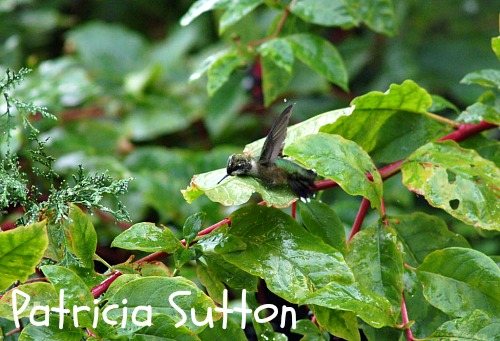
 In nearly all my programs and workshops I recommend adding a MISTER to your wildlife habitat. This suggestion is often met with some confused looks, so I thought I’d follow it up here with some photos that can help walk you through it and understand how simple it can be. NO ELECTRICITY needed, just a hose connection.



 Many (1000s) have taken these workshops, been empowered, and created habitats that have given them pleasure for years to come.
 Consider joining me for one, two, or all six of these workshops.
  So, what do you say! Will I see you in February & March?
 Time: 10:00 a.m. to 3:00 pm.
 Having written the book,


