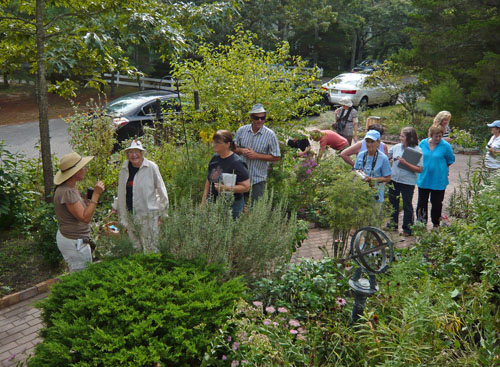
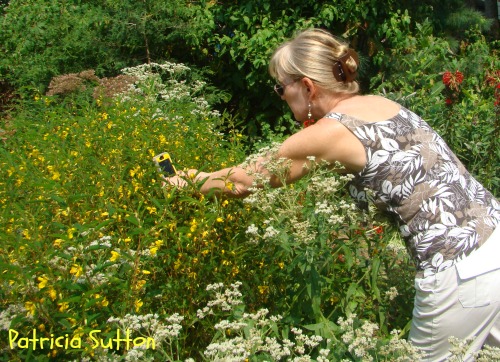
I thought you would enjoy Susan Harris’ Garden Rant post, written after she attended the September 21, 2014 “South Tour of Monarch Gardens,” featuring private backyard and front yard gardens in Cape May, Lower Township, and Cape May Point:
As you can tell from the title, she was quite complimentary. Bravo wildlife gardeners and thank you SO MUCH for letting me share your gardens with tour participants! Keep enjoying your oases and the many wildlife visitors they attract and have fun inspiring others to do the same. If you know anyone who is ripe to be hooked on wildlife gardening, be sure they are aware of the upcoming workshops I’l be teaching: “2015 Gardening for Wildlife Workshop Series.”
Every walk down your garden path is full of wonder: Cloudless Sulphur caterpillars on Partridge Pea
Hi Gang,
I had a ball leading tours of private butterfly gardens in South Texas in early November at the 2014 Texas Butterfly Festival. Leaving Cape May when the butterfly season was coming to a close and heading to an area swimming in butterflies, including many exotic strays from Mexico, was a treat for this wildlife gardener.
Speaking of wildlife gardens I can’t wait to once again teach the series of 6 in-depth
“Gardening for Wildlife” Workshops (pdf) on select Saturdays and Sundays February 28 – March 28, 2015,
the perfect time to shake off winter and begin planning and planting (or enhancing) your property and wildlife garden.
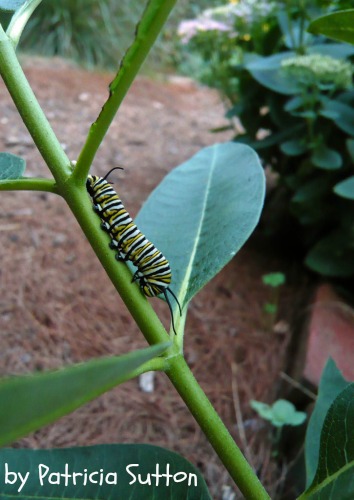
Every walk down your garden path is full of wonder: Monarch caterpillars on Common Milkweed
Learn to create gardens and habitats in little time, save money (by encouraging seed production rather than hampering it with traditional gardening practices), and see long-term results (by implementing wildlife-friendly garden practices rather than traditional wildlife death-trap practices).
Many (1000s) have taken these workshops, been empowered, and created habitats that have given them pleasure for years to come. They know and I know that there is nothing more special than stepping out the door into a habitat that YOU created, a habitat that fills up with wildlife visitors galore: hummingbirds, butterflies, caterpillars, chrysalises, dragonflies, ladybugs, many different native bees, beetles and other fun pollinators, songbirds, frogs, turtles, moths at night, and more! Every walk down your garden path is full of wonder, learning, delight, awe . . . almost like traveling to an exotic land, but that exotic place is your own back (or front) yard. There is nothing more gratifying than knowing that you provide safe haven for all these creatures.
Consider joining me for one, two, three, or all six of these workshops (discounted fees when you sign up for any 3 workshops). Native plants and wildlife-friendly practices are the key and will be emphasized and detailed throughout.
I present a zillion one- to two-hour programs each year and maybe you’ve attended a few of these. I love teaching them, but (with only one or two hours) they are more one-sided presentations, me sharing fun natural history information and images with you, the audience.
These workshops offer the opportunity to be far more in-depth and interactive and are more likely to empower you, take you to the next level.
The 5-hour format (10 a.m. to 3 p.m.) allows for:
an interactive workshop atmosphere
each workshop covers a unique aspect of wildlife gardening (in-depth)
each workshop builds on the others, but is not repetitive (so you’ll want to try and attend all 6 to maximize your learning opportunity)
resources (handouts and circulated books) will be shared and showcased
you’ll learn how to utilize these resources (find answers to burning questions you may have)
time for in-depth questions
time for in-depth answers
during a working lunch we’ll brainstorm (as a group) each participant’s specific challenges (you’ll draw a rough sketch of your yard and submit a photo of your sketch that I’ll project so we can all see it for this brainstorming)
time to get to know one another and learn from each other (of garden triumphs and tribulations, successes and pitfalls). Nothing beats collective experience and roundtable discussion
each workshop will culminate in a site visit to a nearby backyard habitat (including my own and others) where wildlife-friendly practices and design and plant selections will be showcased
Eleanor Engel in her six-year-old meadow
So, what do you say! Will I see you in late February & March?
Take advantage of the discount by signing up for any 3 of the workshops. Sign up today and begin getting ready for the workshops. Draw a rough sketch of your yard, indicating structures (and hardscapes like driveways, decks, etc.), existing habitats (lawn, forest, lone trees, shrub islands, gardens, bird feeding station, brush pile, etc.), and mark NORTH, SOUTH, EAST, WEST on the sketch. Take time to note the sun’s path through your yard and where the sunniest areas are. Begin making a wish list of the elements you want to add as well as the elements you need to work around.
Common Green Darner laying eggs in Sutton’s wildlife pond
Time: 10:00 a.m. to 3:00 pm.
Where: Please note that the 6 workshops in this series will be held at the Cape May Bird Observatory Center for Research & Education, 600 Rt. 47 N, Cape May Court House, NJ 08210 and not at the Nature Center of Cape May in Cape May.
Limit: 20 participants; preregistration required (through NJ Audubon’s Nature Center of Cape May, 1600 Delaware Avenue, Cape May, NJ 08204; 609-898-8848 — if you reach their message machine, do leave a message . . . they’ll get back to you).
Cost/workshop (includes handouts):
$35 member of NJ Audubon Society, $45 nonmember Sign up for any 3 workshops for a discount:
$75 member (or $25 each); $105 nonmember (or $35 each) All workshops include a site visit to a nearby wildlife garden (Sutton’s garden and others).
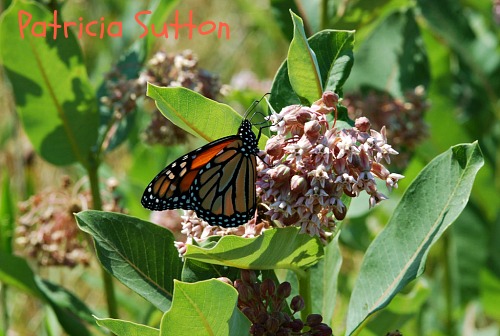
Monarch caterpillar on Common Milkweed in Pat Sutton’s garden August 25, 2014
At the peak of Cape May County’s world-famous fall Monarch migration, tour diverse gardens that have hosted Monarchs since May. Each features native nectar plants and as many as five different kinds of milkweed (used by Monarchs for egg laying to create the next generation). Expect Monarchs and other butterflies, Monarch eggs, caterpillars, and maybe even a chrysalis. The complex Monarch migration will be both explained and enjoyed.
I’ve worked with 18 garden owners to line up this set of Garden Tours. Don’t miss this opportunity to see a fine selection of wildlife gardens with lovely stands of MILKWEED: Common Milkweed, Swamp Milkweed, Butterfly Weed, Whorled Milkweed, Purple Milkweed, and Tropical Milkweed. The annual, Tropical Milkweed, will be in bloom. Most of our native perennial milkweeds have already bloomed, but their robust leaves still pull in mating and egg-laying Monarchs well into the fall, as our local Monarchs create yet another generation. These gardens are coming into their fall attire, which will be as stunning as the summer garden, yet completely different.
2014 TOURS OF PRIVATE MONARCH GARDENS
10:00 a.m. to 3:30 p.m.
Friday, Sept. 19 — Mid-County Tour, including amazing gardens along the Delaware Bayshore in North Cape May and Villas Saturday, Sept. 20 — North Tour, including Pat Sutton’s garden and other gems from Cape May Court House north to South Seaville Sunday, Sept. 21 — South Tour, including gardens south of the Cape May Canal
Expect these gardens to also be hosting lingering hummingbirds, butterflies, caterpillars, stunning native plants, and undoubtedly some surprises. Fall migration will be underway, so anything’s possible.
TOUR DETAILS AND PRICING
Gardening naturalist and author, Pat Sutton, leads these tours, which include her own garden in Goshen (North tour). Bring lunch since the group will eat in one of the gardens. Limit: 25 per tour. Three Tours / Cost per tour: $35 members (NJ Audubon), $45 nonmembers.
(Join three tours at a discounted rate of $90 members, $115 nonmembers.)
These tours require preregistration with payment.
Registration: you may register by phone at 609.898.8848 with a credit card or send payment to the Nature Center of Cape May, 1600 Delaware Avenue, Cape May, NJ 08204 (noting which tours and full names, addresses, and phone numbers of registrants). NCCM reserves the right to cancel programs, and refunds are available only if NCCM cancels the event. Walk-ins are welcome on a space-available basis. Become a member of NJAS and receive discounts in the gift shop and on many programs.
It is the peak of Ruby-throated Hummingbird migration. Numbers have exploded now that young have left the nest, females are busy with second broods, and hummingbirds that nested in the far north (Gaspe Peninsula) are moving south. Gardens designed and planted with hummingbird-friendly plants and a wealth of yummy soft-bodied insects (which hummingbirds also love to eat) are experiencing a virtual blizzard of hummingbirds.
At the peak of Ruby-throated Hummingbird migration, we’ll savor an array of diverse gardens that have hosted nesting hummingbirds since May and are now drawing in dozens of migrants. Native nectar plants, healthy insect populations, water sources, and adequate cover are key elements of each garden.
TOUR DETAILS AND PRICING
Gardening naturalist and author, Pat Sutton, leads these tours, which include her own garden in Goshen (North tour). Bring lunch since the group will eat in one of the gardens.
If some of you are keen to create a butterfly & hummingbird garden, be sure to download the article & plant list Sutton wrote / created:
Limit: 25 per tour. Nine Tours / Cost per tour: $35 members (NJ Audubon), $45 nonmembers. (Join three tours at a discounted rate of $90 members, $115 nonmembers.) These tours require preregistration with payment.
Registration: you may register by phone at 609.898.8848 with a credit card or send payment to the Nature Center of Cape May, 1600 Delaware Avenue, Cape May, NJ 08204 (noting which tours and full names, addresses, and phone numbers of registrants).
NCCM reserves the right to cancel programs, and refunds are available only if NCCM cancels the event. Walk-ins are welcome on a space-available basis. Become a member of NJAS and receive discounts in the gift shop and on many programs.
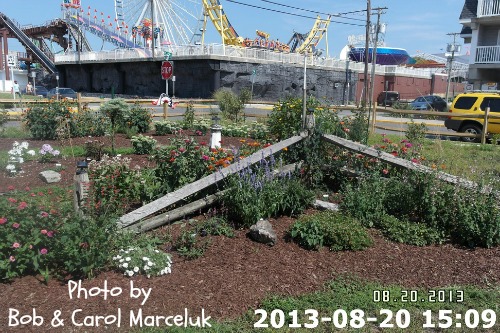
Garden Gang members Bob and Carol Marceluk in Ocean City, NJ, and their WILDLIFE HABITAT were featured in the Press of Atlantic City, Saturday, July 12, 2014: “New Boardwalk Attraction,” by Martin DeAngelis.
I met Bob and Carol in 2012 when I taught a series of Gardening for Wildlife Workshops for the Ocean City Environmental Commission . . . and, as they say, the rest is history!
They transformed a large expanse of boring lawn into gardens full of native nectar plants (that bloom spring through fall), lots and lots of caterpillar plants (including MILKWEED of course), native berry-producing trees and shrubs (for cover and food), water features (including a new pond), neat seating areas. It has given them SO MUCH pleasure and provided an oasis to migrant and resident wildlife.
I wish I was brave enough to add Bob & Carol Marceluk’s habitat to the “Tours of Private Wildlife Gardens” that I lead, but taking people into Ocean City in the summer on a weekend . . . In the future I might plan a special tour to barrier island gardens on a date after the crazy summer tourist season. I’ll keep you posted!
Fellow wildlife-gardening educators Jack and Jesse Connor have brought to my attention 4 bills proposed in the NJ Legislature that we all should be aware of and consider voicing our support.
In short, here are the 4 proposed bills that we can speak up about and show our support:
A3133 Requires DEP to establish “private wildlife habitat certification program”; creates affirmative defense against municipal nuisance ordinances for properties certified under the program.
A3125 Prohibits sale or planting of certain invasive plant species.
A1305 Requires any State entity planting vegetation to use only vegetation native to area being planted, and when purchasing vegetation, to purchase, to the maximum extent possible, only from NJ businesses.
A1373 Prohibits use or sale of neonicotinoid pesticides.
Working with Jack and Jesse, Garden Gang member Jean Riling put together a concise document about these 4 proposed NJ Bills and who to contact (depending on where you live):
Have you (or do you know anyone who has) been harassed for having a wildflower meadow or perennial garden? I do, quite a few in fact. Sadly manicured lawn (“neat as a pin, ugly as sin”) is the norm and any venture towards wildlife habitat in the way of native perennial gardens or meadows in some neighborhoods is seen as a threat. No wonder pollinators are struggling!
Are you fighting English Ivy or Bamboo or Japanese Honeysuckle (all invasives) that are spreading from a neighbor’s yard or were planted by the previous property owner? I have. This bill is an excellent start to help address some of the worst invasives. Once passed hopefully additional invasives can be added to the list.
Many of us have read the articles about European Honey Bees and how their numbers have crashed. Well native bees and many other native pollinators are also in dire straits. Here’s our chance to get Neonicotinoids out of NJ! If you’re unaware of Neonicotinoids, be sure to read Jack Connor’s recent Blog post on South Jersey Butterfly B/Log.
Click on Jean Riling’s document above (Four NJ Bills of Interest as of June 2014) to read more and learn how you can voice your support.
My copy arrived earlier this week and I’m enjoying the book immensely. The authors walk us through and help us understand the layered landscape, something that so many gardeners don’t address, consider, or even know to think about.
I was guilty of it for years and am trying to rectify the situation by making some changes:
incorporate layers under the Tulip Tree that shades our house with understory shrubs and shade-loving wildflowers
incorporate shrub layers in my back side yard where previously lawn had reigned
and my biggest project has been our reclaimed woodland where previously Multiflora Rose grew so thick that there was no understory except for this non-native rose. The woods have given me immense pleasure as I experiment with new understory trees, shrubs, wildflowers, ferns, and grasses. I continue to be amazed by all the native plants that come up on their own (either planted by wildlife or from seeds in the soil that couldn’t survive previously because of the Multiflora Rose). For example, friends gave me 2 baby Willow Oaks and since then I’ve found 5 more that came up on their own.
If you’re intrigued,be sure to get Tallamy & Darke’s new book and digest it. It’s a gem!
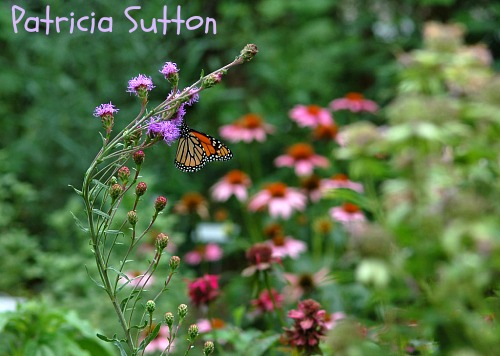
Monarch on Meadow Blazing Star with Purple Coneflowers beyond (both are Chocolate Cakes, irresistible to pollinators)
This is the 23rd year I’ve been leading these tours of private backyard wildlife gardens. And they just keep getting yummier and yummier!
Mark your calendar with the following dates & plan to join me for one, several, or all NINE of the 2014 “Tours of Private Wildlife Gardens” (pdf) that I will again be leading for NJ Audubon’s Nature Center of Cape May.
Alert your friends, family, neighbors, … anyone you’re trying to HOOK on wildlife gardening!
We’ll be visiting 18 gardens over a 3-day period – six delightful and unique gardens each day. These wildlife-friendly gardens offer so many ideas in the way of design, use of space, plant combinations, native plants that are lovely AND beneficial to wildlife, “chocolate cake” nectar plants, key caterpillar plants, great native shrub ideas, “how to” create your own meadow ideas, garden accents and features like misters, dragonfly ponds, arbors . . .
Imagine getting a glimpse into private backyard wildlife gardens, interacting with the artists who created them, having each and every garden and wildlife question answered, enjoying it with a group of fellow wildlife gardeners, all while being entertained by buzzing and hungry and feisty hummingbirds, dazzling dragonflies, glittering butterflies and other pollinators! Sounds heavenly, doesn’t it ? !
Enjoy a SNEAK PEAK (South Tour, North Tour, Mid-County Tour) into some of the gardens we’ve visited in the past. I’ve updated these links to include many new gardens added in recent years.
Pollinators galore (Sachem and Bumble Bee) are drawn to Purple Coneflower
More butterfly and hummingbird gardens are tucked into Cape May County than probably anywhere else in the country. Mid-July is the time of peak butterfly diversity and numbers. Gardens look completely different from one month to the next (so seriously consider all 9 tours). Learn the magic combination of native nectar plants and caterpillar plants that makes a garden especially attractive to butterflies. Design ideas and new wildlife plants will be showcased while tour participants are entertained by a blizzard of butterflies and hummingbirds.
Tours of Private HUMMINGBIRD Gardens — 10 a.m. to 3:30 p.m.
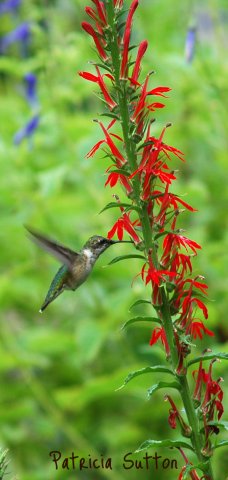
Female Ruby-throated Hummingbird nectaring on Bee Balm
At the peak of Ruby-throated Hummingbird migration, we’ll savor an array of diverse gardens that have hosted nesting hummingbirds since May and are now drawing in dozens of migrants. Native nectar plants, healthy insect populations, water sources, and adequate cover are key elements of each garden.
Tours of Private MONARCH (butterfly) Gardens — 10 a.m. to 3:30 p.m.
Monarchs and a hungry Preying Mantis have come to dine on New England Aster
At the peak of Cape May County’s world-famous fall Monarch migration, tour diverse gardens that have hosted Monarchs since May. Each features native nectar plants and as many as five different kinds of milkweed (used by Monarchs for egg laying to create the next generation). With the downward spiral of the Monarch population, time will tell, but we hope our gardens will be hosting Monarchs and Monarch eggs, caterpillars, and maybe even a chrysalis. The complex Monarch migration will be both explained and enjoyed. Fall gardens will be full of other butterflies and many interesting pollinators.
TOUR DETAILS AND PRICING
Gardening naturalist and author, Pat Sutton, leads these tours, which include her own garden in Goshen (North tour). Bring lunch since the group will eat in one of the gardens.
If some of you are keen to create a butterfly & hummingbird garden, be sure to download the article & plant list I wrote / created:
Limit: 25 per tour. Nine Tours / Cost per tour: $35 members (NJ Audubon), $45 nonmembers. (Join three tours at a discounted rate of $90 members, $115 nonmembers.) These tours require preregistration with payment.
Registration: you may register by phone at 609.898.8848 with a credit card or send payment to the Nature Center of Cape May, 1600 Delaware Avenue, Cape May, NJ 08204 (noting which tours and full names, addresses, and phone numbers of registrants).
NCCM reserves the right to cancel programs, and refunds are available only if NCCM cancels the event. Walk-ins are welcome on a space-available basis. Become a member of NJAS and receive discounts in the gift shop and on many programs.
Yesterday, Saturday, April 12, was a good day! Hope you got out to enjoy it too. Clay and I went to Cape May Point to join Tom Reed in his SPRING WATCH.
The highlight for me was when Tom called out: ” HUMMINGBIRD ! ! ! “
At 8:55 a.m. Tom spotted a Ruby-throated Hummingbird migrating north across Delaware Bay, heading for the tip of the Cape May Peninsula. It was at the top of a cloud bank, higher than I would have expected. I was scanning like mad low over the choppy waves of Delaware Bay.
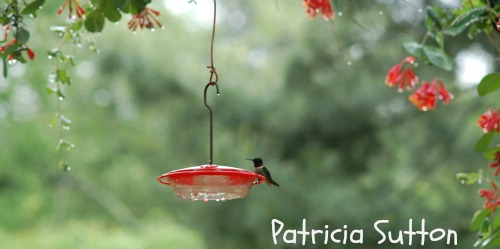
According to Hummingbirds.net the first NJ sighting was on Friday, April 11. I hung 3 feeders (with only about 2 ounces in each) earlier in the week, seeing that they were already as far north as across the Delaware Bay.
We haven’t seen one in our yard Y E T, but expect a feisty male to find our feeders and settle in by the end of this coming week or next. Our gardens are not much yet, so feeders are crucial if you hope to entice hummingbirds to settle in. Then be sure to have a jam packed garden and habitat full of native plants that bloom from early spring through fall. Too, maintain those feeders so they offer something as fresh as nectar . . . hence why you don’t fill them to the brim (since you’ll be dumping the solution at least once a week, cleaning, and partially filling with fresh solution). Oh, and NO RED DYE! It’s cancer causing, so DUH . . . who wants to do that to hummingbirds?
WANT TO LEARN MORE ?
Join me for the following fun and informative program that I will be teaching for NJ Audubon’s Nature Center of Cape May,1600 Delaware Avenue, Cape May, NJ 08204; 609-898-8848.
RUBY-THROATED HUMMINGBIRDS 101 All About Them and How to Attract Them (with Pat Sutton) Saturday, April 19, 2014 1:00 to 3:00 p.m.
Learn where Ruby-throated Hummingbirds have they been all winter. Will more than one settle into your backyard garden? Where is the nest? What does the female use to build her tiny nest? Is bottled nectar (or red dye) needed for a feeder? What are the two reasons hummingbirds like spiders? Even if you think you know everything about these winged jewels, expect to be surprised by what you learn during this presentation by Pat Sutton, naturalist and long-time wildlife gardener. Sutton will show off an actual hummingbird nest and share essential tips on how to ready your yard so that you can be entertained by a blizzard of hummingbirds for the next five months. Before this program, download, print, and read the NJ Audubon articles by Pat Sutton: “How to Create a Butterfly and Hummingbird Garden” and “Recommended Plantings to Attract Hummingbirds, Butterflies, and Moths.” Limit: 20 participants. Preregistration is required (through NJ Audubon’s Nature Center of Cape May, 1600 Delaware Avenue, Cape May, NJ 08204; 609-898-8848) Cost: members $15, nonmembers $20 (includes handouts and FREE Tropical Salvia seeds)
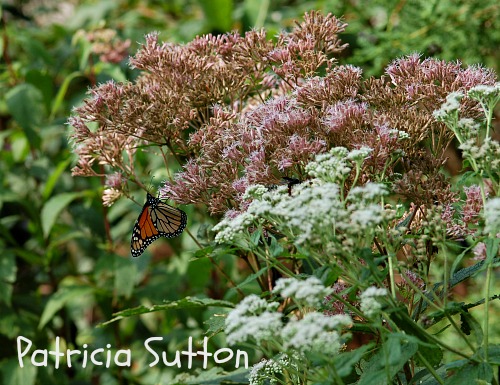
Monarch nectaring on Joe-pye-weed with Boneset in the foreground – TWO great Eupatoriums
If you’re looking for some fun plants to add to your wildlife garden, seriously consider the Eupatoriums:
1. They are stunning2. A selection of them can cover a good part of the growing season3. They are pollinator magnets4. Monarchs LOVE them and Monarchs need all the help they can get